Showing posts with label Fermentation. Show all posts

Thursday, July 25, 2013

Yeast Cake


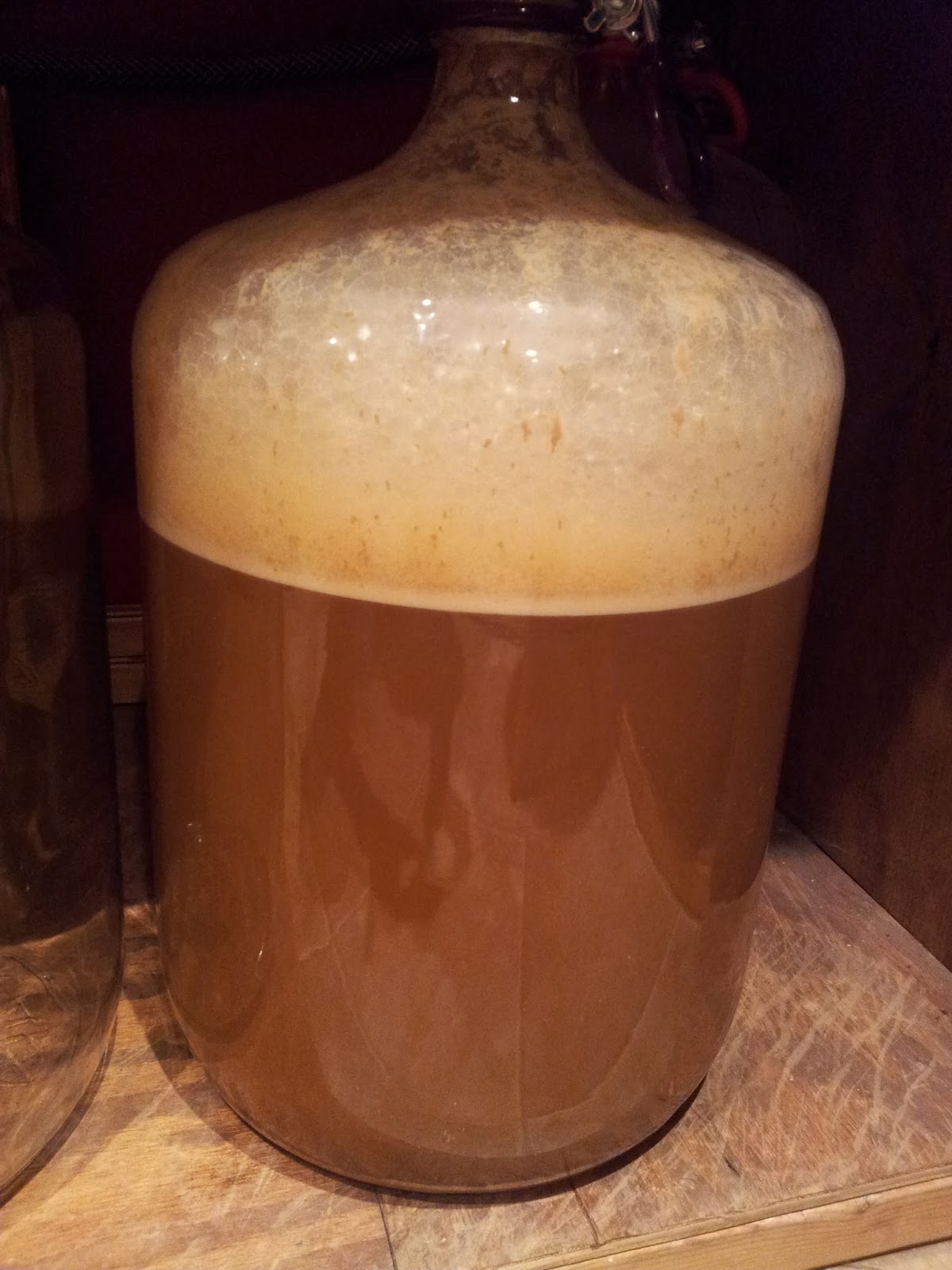
This is a 6.5 gallon fermentor, the Krausen clogged up the first airlock and it had to be switched out with a second one.
 The Pale Tranquility seems to be humming along nicely now. This was the first time that I have attempted to pitch a new batch of wort onto an existing Yeast Cake of the same strain.

This particular one was WLP001, California Ale yeast left over from my second batch of Sky Blue (The Blue Moon Clone). Technically I didn't pitch it into the same fermentor as it had the leftover ring of Krausen still clinging to the inside. Instead I used a sanitized container and funnel to transfer the existing yeast slurry out. The funnel has a built in screen so it was able to keep left over trub from the Sky Blue from intruding into the new wort.

It took about 30 hours for the yeast to take off, but once it did it took off with a vengence. Previous uses of WLP001 never achieved this level of vigor. Within 12 hours of the first signs of activity the airlock was semi-clogged due to the krausen filling up all the headspace. This one probably could have used a blow off tube, if I had known in advance that it would have performed like this then I would have set it up. Either way, it didn't make any mess at all and is happily churning away.

My next planned beer is probably going to be an Oktoberfest so I won't be able to use this same yeast right out of the fermentor. I will happily wash this batch though and store it for later use.

Friday, March 15, 2013

The eternal Krausen

The Blue Moon Clone I brewed over the weekend still has a 2 inch Krausen on it. It first formed within 18 hours of being pitched and has been going strong ever since. You can see the little yeasties happily chugging up and down in the carboy, and it has been 6 days already!

The Smithwicks won't be finished in time for St Pats tomorrow, unfortunately. There is still airlock activity as of last night, albiet quite slow. I don't even have time to cold crash and do a super-fast carb job on it, not and do it justice. It has to be ready and able to bottle from the keg by the 23rd though, so I'm hoping it hurries up. I need at least 48 hours to crash the yeast or it will be way to cloudy for judging.

Thursday, January 10, 2013

Ranger Danger in the Kegger

Took the Ranger IPA clone out of the fridge from cold crashing tonight. It had a lot of hops floating on the top when I put it in, cold crashing made all of it sink. That kind of surprised me a little. I know it helps particulates to settle out, as in yeasts, and other small size matter. But the whole leafs that were floating on top were also affected.

Tested the gravity as well.
OG: 1.059
FG: 1.005
ABV 7.2%

Tasted very very good even though it was not carbed yet. Looking forward to this one very much as it was the first AG brew I finished.

One of my brewing friends will be over this weekend, but I don't think this one will be quite ready by then, although sampling will be done with gusto!

Sunday, January 6, 2013

Failure

The Dunkle has gone down the drain.

This is not the first beer that I have dumped. I brewed the Dunkle back before Thanksgiving. OG measured out at 1.058, which was right on target. After the first week, Krausen had fallen, things were looking good and I took my first gravity reading. It was a disappointing 1.024 when my target was 1.013. I gave it another week and checked the gravity again, it was still 1.024. It hadn't budged a single point in a week.

Thanksgiving came, and I went out of town for the holiday. I figured that I could give the beer another week or two with no problems at all, I still had a couple on tap, plus more to keg while it sorted itself out. It never did drop below 1.024, so all of the following has a big question in my mind on whether or not it was due to the gravity stall. I figured I'd go with it regardless when a keg opened up.

I left it alone after the second gravity reading was showing no movement and bypassed it in kegging order with the Black IPA (which is still tasty). Once the English Pale was finished right around Christmas I had an open tap to fill so I pulled out the Dunkle.

From the get go I thought I might possibly have an issue. I should have taken a picture, but unfortunately I didn't. Most of the time with long fermentation times, and this one was going on 6 weeks in primary, you have a nice clean looking beer. This particular one looked like it might have had some residual CO2 bubbles still on the surface, not much at all really. I cold crashed it for a few days as I normally do before I keg anything.

Once I pulled it out of the fridge to transfer it to a keg I got a closer look. The only way I can describe it was that it appeared to have very tiny (about 1 mm across at the largest) white spheres on the surface. It was by no means pervasive, maybe several dozen or so and like I said, tiny looking. In 5 gallons of beer, not really very much at all. As I was transferring to the keg, I noticed a few dozen more along the sides of the carboy, and some on the surface of the racking cane. At this point I was already worried about an infection in the beer, I tasted it as well and thought that it might have 'something' off about it but it wasn't carbed yet so wasn't totally sure.

In the keg it went, and got carbed up. After a few days at high pressure I tasted it again, and I wasn't sure whether or not my paranoia was kicking in, but it just tasted a bit ..... off. Hard to describe, other than a bit of a chemically taste to it. This is one of the reasons I want to train as a judge, so that I can tell exactly what is going on, even in a bad beer.

I kept it on tap for a while to see if it would mellow with full carb. Drank a few pints of it myself, and took a growler of the Dunkle and the Black IPA to a house party on New Years Eve. Everyone loved the Black IPA, but were all 'meh' on the Dunkle. I just couldn't get over my own paranoia that it was infected with something.

I gave it another go tonight, and I thought that I had worked past the paranoia, or the flavors had mellowed and it might be alright. But....... I had also just eaten a dill pickle before tasting it. Once I cleansed my palate of the dill, I tried again, and sure enough the strange chemical taste was still there.

Down the drain it went. I know you can drink a beer that has been infected, it won't do you any harm. But I just can't keep 5 gallons of it on tap and force my way through it at the leisurely pace that I consume my beer now. I also won't force it on my wife, who is a party to all my doubts about any beer. She knows I thought it might be infected, I won't keep anything like that from her and make her a gueinea pig.

The only bad thing is, I've never made a Dunkleweise before, so I had no base of comparison on that, but I've made plenty of Hefes to know that this one wasn't quite right.

Now the Ranger Danger is cold crashing to take it's place in the keg lineup. That one I am really looking forward to as it was my first AG beer. An associate of mine pointed me to the recipe, and he has his example so that we can compare as well.

My thoughts on what could have happened? Well, I must not have been diligent enough in sanitizing my beer thief. That was the only object that went into the beer once it was in the carboy. It is the only possible source of an infection. The Black IPA was tested at the same time with the same beer thief, but it is just fine. It also went into a keg several weeks ahead of the Dunkle. If the infection that I suspect was introduced by taking sample readings, the Dunkle had more time for it to take hold.

I've checked both the Ranger Danger and the Brown Turkey that are still in carboys and neither of them exhibit the same symptoms. Neither of them have had their airlocks off of them since they were brewed and neither show any signs of infection.

Either way, I'm now going to be scrubbing the crap out of my beer thief and racking cane. I'm also going to toss out all the fluid lines I use post brew, I have plenty to spare.

It is disappointing to have to dump out nearly a full keg of beer, but I have plenty more to drink. This is also not the first infection I have had. My peach experiment got infected much worse than this one. It was very obvious with big bulbous fuzzy growth all over the peaches. That one only got away from me because that was during the week that my daughter was born and I couldn't tend to the peaches soaking in the completed beer at all (you have to keep the peaches submerged to avoid the possibility).

It is a one of those learning experiences that keeps you on your toes about disinfecting everything that may come into contact with the beer.

Live and learn.

Another question I have to deal with now. I washed and saved the yeast from that carboy, is this going to have the same infection (if thats what it was) lurking around in the yeast samples I saved. I think it might, and to assuage my paranoia I think I am going to have to dump out the yeast samples. No big deal, I'm not even really sure what yeast strain it is, it came from a Brewers Best kit from the LHBS. It won't kill me to dump them.
Wednesday, December 26, 2012

Choices

During the holiday weekend (which I took a break from the 'nets so no new posts here), my family visits helped with emptying out the English Pale that had been on tap since just after Thanksgiving.

Now I have to pick between 3 different ready to keg beers:

Dunkleweiss
Ranger IPA clone
Northern English Brown

The Dunkle has been in the fermentor the longest time, and I already have a Black IPA on tap...
The NEB hasn't even been checked for final gravity yet...

Dunkle it is!

Also, my lovely wife gave me a pressure cooker for Christmas, now I can sterilize jars, lids, implements, etc, for yeast washing and storing.

I'll be getting to that next, washing the yeast cakes in order to store my own like bank.

Sunday, December 16, 2012

Major Difference

So the Brown Turkey is happily percolating this morning with an inch of Krausen already fully formed.

For the majority of the this year I have been using dry yeast in all of my brews for a couple reasons. Locally sourced kits were all dry yeast, and when ordering over the internet in the middle of the summer heat I tended to use the dry option as well. I didn't want to have complications with shipping liquid yeasts and having the heat kill them off before I received them.

I had been spoiled by the quick action of dry yeast. Dry yeast is packaged when the yeast has already been through the O2 uptake phase, making them set to go as soon as they rehydrate from the wort.

Other times I used Wyeast smack packs, which also tend to take off rather quickly. It really only seems to be White Labs that takes a while for the yeast to go through the O2 uptake phase prior to getting down to work. With the Ranger Danger IPA I did a few weeks ago, it was 36 hours or so before I started noticing any airlock activity.

This time around using the White Labs yeast, I made a starter on Thursday evening to get it all kick started.
2 cups of water and 1/2 cup of wort boiled for 15 mins, then chilled down and yeast pitched in. I haven't made a stir plate for it yet, but the yeast burned through that little amount of wort in 24 hours.

Using that starter has made a world of difference with this brew.

I'm happy.

Monday, December 3, 2012

Krausen

So of course my paranoia was unjustified, I came home from work to find a nice Krausen forming (a hoppy green tinted one to be sure).

Bubble bubble toil and trouble....

Sunday, December 2, 2012

Bad Yeast?

It's been 29 hours since I picthed the yeast on the Ranger Danger and there is no activity at all in the fermentor. The date on the yeast stated it was good until Jan 2013 (WLP051 from LHBS). I know it is still a bit to early to pass judgement, but I've never had a yeast take this long to begin activity.

Meh.....

Update:
I checked it again in the early morning hours when I was up feeding the baby, and now there is the beginning of activity in the airlock. I'll keep an eye on it, but I think it is finally starting to take off.